Classification with SVM
binary classification 의 핵심은 차원 공간에 존재하는 example 들을 레이블에 따라 두 파티션으로 나눈다는 것이다. 이때, 공간을 나누는 역할을 hyperplane 이 맡게된다.
- 차원 hyperplane 의 한쪽에 있는 경우
Hyperplane
만약, example 데이터 공간에 존재한다 가정하고, 다음과 같은 함수 를 생각해보자.
- and
hyperplane 은 affine subspaces 이기 때문에, 다음과 같이 이진 분류 문제를 위한 hyperplane 을 정의할 수 있다
이때, 는 hyperplane 에 대해 normal vector 를 만족하도록 구하면 되는데, 이는 hyperplane 에 존재하는 두 examples and 에 대해, 두 사이의 벡터가 에 대해 orthogonal 함을 보이는 를 선택하면 된다. 예를 들어 다음과 같은 식을 고려해보면,
and 를 만족하므로 임을 알 수 있다 (orthogonal).
hyperplane 을 구했다면, test example 에 대해서 다음과 같이 prediction 을 진행할 수 있다: 값이 0 보다 크거나 같으면 이고, 그렇지 않으면 (이는 마치 hyperplane 위에 positive example 이 놓여있고, 아래에 negative example 이 놓여 있는 것으로 생각할 수 있다).
이러한 두 조건을 하나의 식으로 표현하면 다음과 같다.
 Equation of a separating hyperplane
Primal SVM
실제로 분류 loss가 없게끔 하는 많은 hyperplane이 존재할 수 있다. 그러나 unique solution은 positive 와 negative example들을 최대 margin으로 나눌 수 있는 hyperplane이다.
Reference
mathematics machine learning : ch 12. Classification with SVM
- large margin classification
- Alternative view of logistic regression
- Logistic Regression식을 바꾸는 방식으로 Support Vector Machine(SVM)의 식을 구성할 수 있다.
- Activation function이 sigmoid function인 Logistic Regression의 loss function 을 생각해보자
:
- 이 함수는 의 경우 는 1에 가까워야 할 것이고, 이는 를 만족해야 한다.
- 반대로, 의 경우 는 0에 가까워야 할 것이고, 이는 을 만족해야 한다.
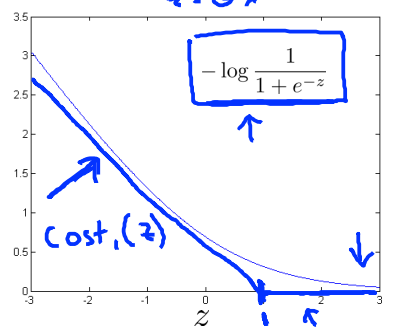
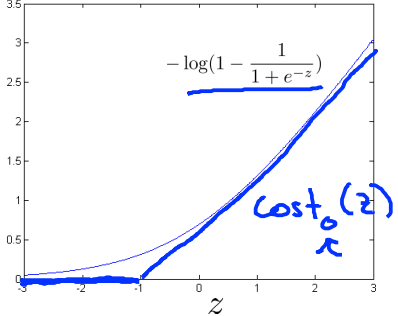
- 이제, 의 두가지 경우에 대해서 의 graph를 다음과 같이 바꿔보자.
- 일 때 얻어지는 를 로 바꾼다 ().
- 일 때 얻어지는 를 로 바꾼다 ().
- 일 때 얻어지는 를 로 바꾼다 ().
- 결과적으로 regularization term까지 포함한 logistic regression의 cost function (decision boundary)은 다음과 같이 바뀔 수 있다.
Logistic regression
- Support Vector Machine - 여기서 일 경우 Logistic Regression의 식과 동일한 최적화 값을 가질 것이다.
- Decision Boundary
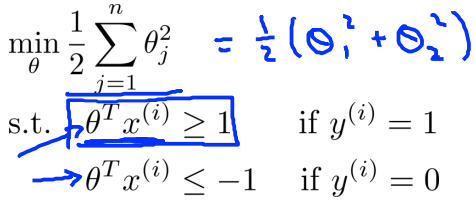
- Logistic regression과 마찬가지로, SVM도 일 경우와 일 경우로 나눠볼 수 있다.
- SVM의 decision boundary의 두 가지 case
- 의 경우는 를 만족해야 한다 ( 그림 참조).
- 의 경우는 를 만족해야 한다 ( 그림 참조).
- 각각의 경우를 고려하면, ( 또는 가 0이 되므로), SVM은 아래와 같이 심플하게 표현된다 :
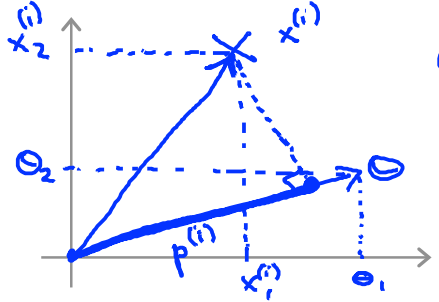
- 즉, SVM Decision Boundary는 라는 vector와 라는 벡터의 dot product이라고 생각할 수 있다.
Large Margin Intuition
- SVM은 분류된 점에 대해서 가장 가까운 학습 데이터와 가장 먼 거리를 가지는 boundary를 찾는다.
- 만약, 그러지 못한(먼 거리를 가지지 못한) boundary를 가진다면, 어떻게 되는가?
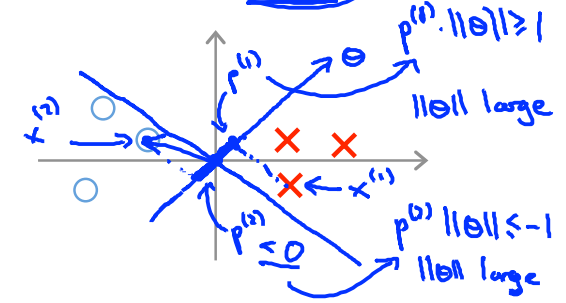
- 위의 그림에서 O와 X는 boundary에 상당히 가깝다.
- boundary와 수직인 와 각 data들 의 내적을 고려할 경우 값은 상당히 작으므로, 올바른 분류를 위해서는 가 커야한다.
- 올바른 분류란, O와 X를 위해 또는 를 만족해야 하는 것을 의미한다.
- 그런데, 가 커지면, cost function이 커지므로, 이를 최소화 하는 방향으로 boundary를 조정하게 된다.
- 최적의 boundary는 아래와 같이 만들어 진다.
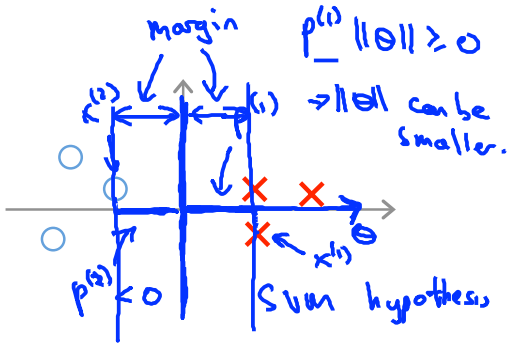
- 위 그림에서 O와 X는 boundary에 충분히 멀다.
- boundary와 수직인 와 각 data들 의 내적을 고려할 경우 값은 상당히 크므로, 올바른 분류를 위해서는 가 작아야한다.
- 가 작아지면, cost function도 작아지므로, SVM이 올바르게 학습되는 것을 확인할 수 있다.
-
Kernels
- 추가적인 features들을 활용해서 complex non-linear boundary를 구성할 수 있게 도와주는 function
- Gaussian Kernel